

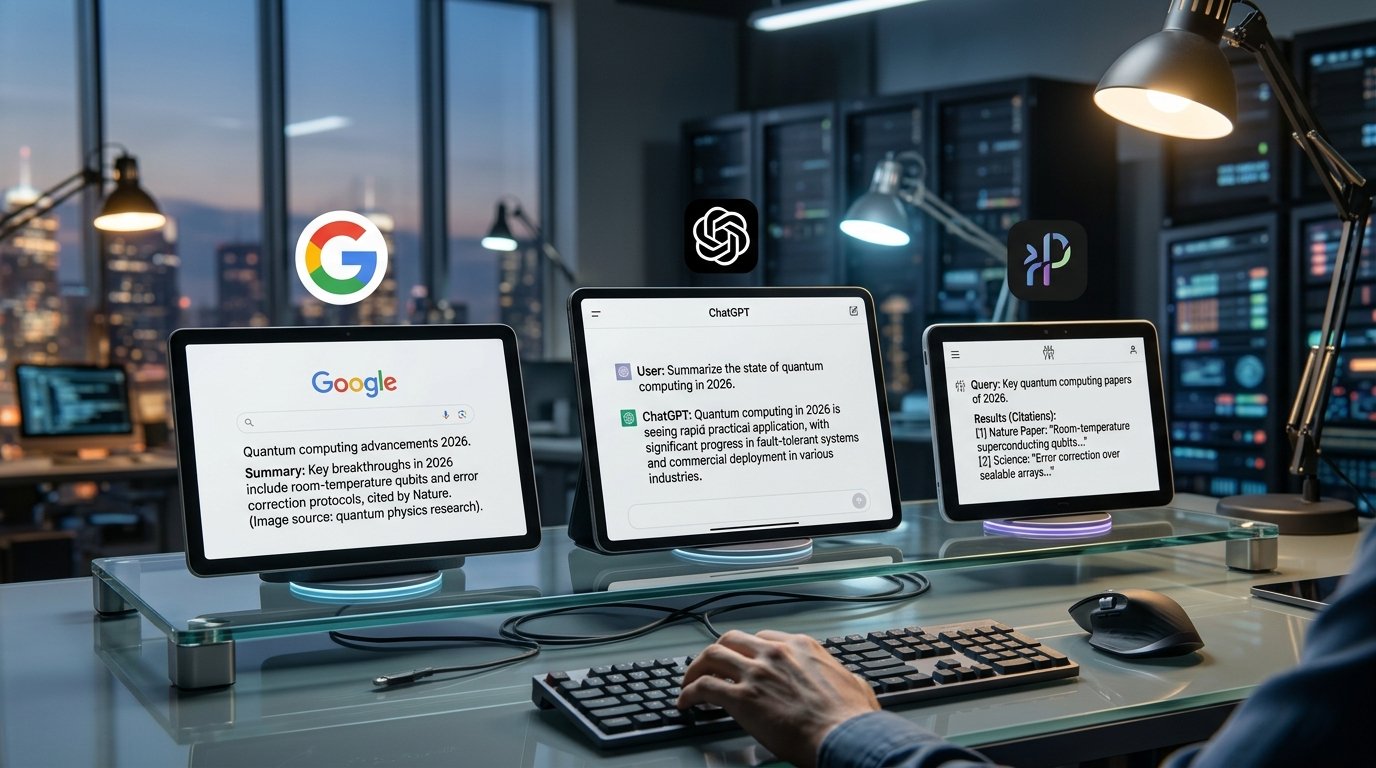
Google AI Mode, ChatGPT, and Perplexity all promise better answers than a list of blue links. Here is how each one performs, where it fails, and which to use for your work.
Table of Contents
- How AI search changed the way we look things up
- Google AI Mode: the default that keeps getting smarter
- ChatGPT: search that turns into work
- Perplexity: the research specialist
- Head-to-head comparison
- Which tool fits which person
- Where all three still fall short
- The verdict
Introduction
No single tool is winning outright. Google AI Mode leads on reach and convenience, Perplexity leads on cited research, and ChatGPT leads when a search needs to become a finished piece of work. Which one is “winning” depends on what you do with your search results.
I’ve been switching between all three for content research, tool reviews, and everyday questions. This post shows where each one earns its place and where it lets you down.
How AI Search Changed the Way We Look Things Up
Search used to mean typing a keyword, scanning ten links, and stitching the answer together yourself. AI search flips that process. You ask a full question, and the tool reads the sources and writes the answer for you.
That shift matters because the three tools below solve the same problem with different priorities. Google AI Mode prioritizes the open web and your existing Google habits. Perplexity prioritizes transparent sourcing. ChatGPT prioritizes conversation and output.
Google AI Mode: The Default That Keeps Getting Smarter
Google AI Mode is the most convenient option because you are probably already inside Google. It sits within Search, so there is no new app, no new account habit, and no learning curve.
Where it shines:
- Multi-part questions. Ask something like “compare three laptops for video editing under a tight budget,” and it breaks the question into sub-searches and combines the results.
- Shopping and local queries. Google’s product listings, maps, and business data give it an edge the other two cannot fully match.
- Follow-ups. You can keep refining without starting over.
The trade-off is control. Google decides which sources to surface, and the answer often feels polished but shallow when you need to verify a claim. It is also designed to keep you in Google’s ecosystem, which is not always what a researcher wants.
Best for: quick answers, shopping, local searches, and anyone who wants AI help without changing their routine.
ChatGPT: Search That Turns Into Work
ChatGPT’s strength is what happens after the search. You can ask it to find information, then immediately turn that information into an email, a spreadsheet outline, a blog draft, or a study plan, all in the same conversation.

Its search feature pulls live web results, but the real advantage is context. It remembers what you said three messages ago, so “now make that shorter and add a table” just works. For freelancers, students, and content creators, that workflow saves more time than any single search result.
The weak points are real, though:
- Its sourcing is less prominent than Perplexity’s, so checking claims takes extra effort.
- It can sound confident while being wrong, especially on fast-changing topics.
- Search is one feature among many, so it can feel less focused as a pure research tool.
Best for: drafting, brainstorming, analysis, and any task where the answer is just the starting point.
Perplexity: The Research Specialist
Perplexity is built around one idea: show your sources. Every answer comes with numbered citations you can click, which makes fact-checking fast instead of painful.
That design choice changes how you work. Instead of asking “can I trust this?”, you open the source and see for yourself. Its focus modes and research-style features also suit deeper investigations, like comparing viewpoints on a topic or building a reading list.
Where it falls short:
- It is less useful for creative or long-form writing.
- Quality depends heavily on the sources it picks, and it sometimes leans on weaker pages.
- It lacks the built-in reach of Google’s shopping, maps, and local data.
Best for: students, writers, analysts, and anyone who needs answers they can verify.
Head-to-Head Comparison
| Feature | Google AI Mode | ChatGPT | Perplexity |
|---|---|---|---|
| Source transparency | Moderate | Moderate | Strongest |
| Conversation and follow-ups | Good | Strongest | Good |
| Shopping and local results | Strongest | Limited | Limited |
| Writing and content creation | Limited | Strongest | Limited |
| Deep research | Good | Good | Strongest |
| Ease of access | Strongest | Good | Good |
| Learning curve | Lowest | Low | Low |
The pattern is clear: each tool owns a different job. Google answers, ChatGPT creates, and Perplexity verifies.
Which Tool Fits Which Person
Instead of picking a winner, match the tool to your task:
- You are a student writing an essay. Start with Perplexity to gather sources, then use ChatGPT to organize your outline.
- You are a freelancer or marketer. Use ChatGPT for drafts and client deliverables, and Perplexity to confirm facts before you publish.
- You are shopping or planning a trip. Google AI Mode handles prices, reviews, and maps in one place.
- You are a blogger or content creator. Combine Perplexity for research with ChatGPT for writing. Use Google AI Mode to see what searchers are actually being shown.
A two-tool setup beats a single favorite. Most people I know who work online end up pairing Perplexity with ChatGPT, then using Google AI Mode for everyday lookups.
Where All Three Still Fall Short
It would be dishonest to call any of these tools finished. Three problems show up across all of them:
- Hallucinations. Every tool can state something false with total confidence. Citations reduce the risk but do not remove it.
- Source bias. AI search favors pages that are already visible and well-structured, which can bury smaller, original voices.
- Fast-moving topics. For breaking news, prices, or recent policy changes, you should still open the original source.
Treat AI search as a fast first draft of understanding, not the final word. Anything that affects money, health, or your reputation deserves a manual check.
The Verdict
If I had to name a winner by category:
- Most convenient: Google AI Mode
- Most trustworthy for research: Perplexity
- Most useful for getting work done: ChatGPT
So who is winning in 2026? Google wins on distribution, Perplexity wins on trust, and ChatGPT wins on productivity. The smartest move is not choosing one side. It is knowing which tool to open for which task.
Try this for a week: run the same question through all three, compare the answers, and notice which one you actually trust and use. That small experiment will tell you more than any ranking.
- Google AI Mode vs ChatGPT vs Perplexity: Which AI Search Tool Is Winning in 2026?
 Google AI Mode, ChatGPT, and Perplexity all promise better answers than a list of blue links. Here is how each one performs, where it fails, and which to use for your work. Table of Contents Introduction No single tool is winning outright. Google AI Mode leads on… Read more: Google AI Mode vs ChatGPT vs Perplexity: Which AI Search Tool Is Winning in 2026?
- How GPT-6 Intelligent UI Makes ChatGPT More Interactive, Visual, and ProductiveChatGPT is becoming more than a chatbot that responds with paragraphs of text. With GPT-6 and its new Intelligent UI feature, answers can include interactive charts, visual explanations, forms, buttons, and small tools that users can operate directly inside a conversation. Announced on October 7, 2026, Intelligent… Read more: How GPT-6 Intelligent UI Makes ChatGPT More Interactive, Visual, and Productive
- Best AI Tools for Content Creators in 2026: A Practical Free-and-Paid Guide
 AI tools can help content creators research topics, write articles, design graphics, edit videos, and publish content faster. But choosing the right tools can be difficult when hundreds of platforms promise similar results. In this guide, we explore useful AI tools for bloggers, freelancers, marketers, and social… Read more: Best AI Tools for Content Creators in 2026: A Practical Free-and-Paid Guide
- Meta Muse for Small Business: What It Can Do for Entrepreneurs in 2026Meta Muse for Small Business is an AI agent designed to help entrepreneurs coordinate work across connected apps. Learn its 2026 use cases, limits, approval controls, and practical adoption steps.
- Google Gemini Agent for Work: What It Means for Small Businesses in 2026Google is pushing AI assistants beyond chat. In October 2026, Google Cloud introduced a Gemini agent for work designed to help with tasks such as answering questions, managing work, creating content and coding. For small businesses, the bigger story is not another chatbot. It is the move… Read more: Google Gemini Agent for Work: What It Means for Small Businesses in 2026