



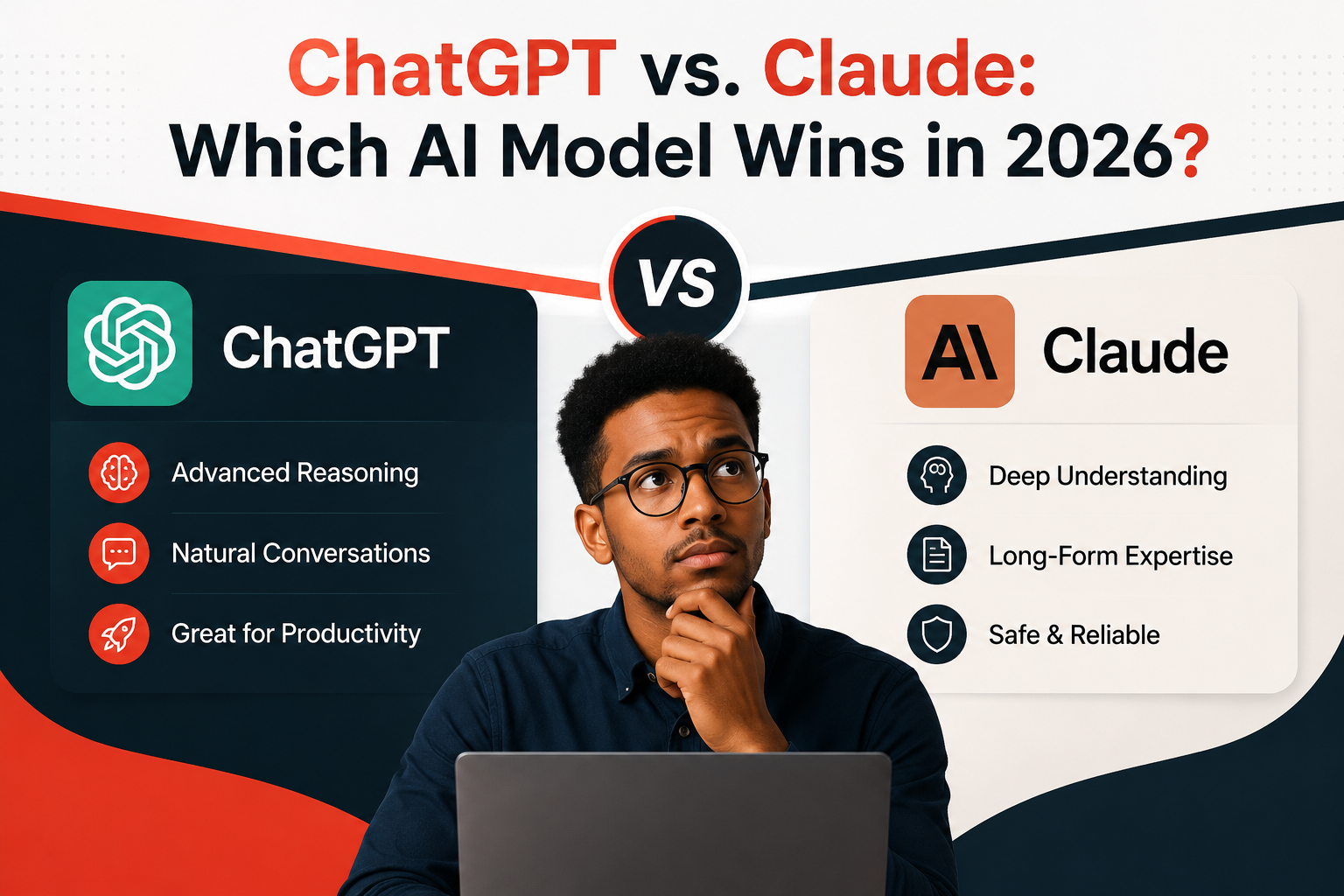
Let’s be honest — a year ago you could pick an AI chatbot the way you pick a phone case. Grab whichever one’s cheapest, move on with your life. Not anymore.
In 2026, “which AI should I use?” is basically asking “which co-founder should I hire?” You’re not just picking a chat window anymore. You’re picking something that writes your emails, debugs your code, reads your 80-page PDF at 2 a.m., and — if you let it — runs entire chunks of your workflow while you sleep.
So: ChatGPT or Claude. Which one actually wins in 2026?
Short answer: it depends on what you’re winning at. Long answer: keep reading, because I’ve dug through the actual pricing pages, the benchmark numbers, and the fine print both companies hope you skim past.
The quick answer (if you’re in a hurry)
| If you need… | Go with |
|---|---|
| The cheapest way to get a frontier-ish model for free | ChatGPT (Free tier runs GPT-5.5 with caps) |
| Long, careful writing — essays, ebooks, reports | Claude |
| A coding agent that finishes the job instead of stopping halfway | Claude (Sonnet 5 or Opus 4.8) |
| Image generation, Sora video, huge ecosystem of plugins | ChatGPT |
| Reading and reasoning across a massive document (or ten of them) | Claude (1M token context) |
| The absolute lowest monthly bill for casual use | Both have solid free tiers — it’s a toss-up |
Now let’s actually dig into why.
What’s under the hood right now
Here’s the thing nobody tells you: both companies release new models so often in 2026 that half the “Chart GPT vs Claude” content online is already stale by the time it’s published. So let’s nail down exactly what’s current as of right now.
OpenAI’s lineup: GPT-5.5 is the current flagship, having replaced GPT-5.4 as the default in April 2026. Free users get GPT-5.3 Instant with a cap of around 10 messages every 5 hours before they’re bumped to a lighter model. Paid tiers unlock GPT-5.5 more fully, plus a “Thinking” mode for harder reasoning and a “Pro” mode for the heaviest tasks.
Anthropic’s lineup: Claude Sonnet 5 launched June 30, 2026, as the new default across Free and Pro plans, with Claude Opus 4.8 sitting above it as the flagship for the hardest reasoning and coding work. There’s also a new tier above Opus called Mythos — Claude Fable 5 is the safety-hardened version of it — but that’s priced and positioned for heavier, more specialized use, not everyday chatting.
| Model tier | OpenAI | Anthropic |
|---|---|---|
| Free default | GPT-5.3 Instant (falls back to Mini after ~10 msgs/5hr) | Claude Sonnet 5 |
| Everyday flagship | GPT-5.5 | Claude Sonnet 5 |
| Deep reasoning / heaviest tasks | GPT-5.5 Pro | Claude Opus 4.8 |
| Top-of-lineup | GPT-5.5 Pro | Claude Fable 5 (Mythos tier) |
| Context window | Up to 256K–1M depending on tier | 1M tokens (standard on Sonnet 5 and Opus 4.8) |
Both companies retired their older models this year — OpenAI sunset GPT-4o and the original GPT-5 back in February, and Anthropic has steadily phased out earlier Claude 4.x versions as Sonnet 5 and Opus 4.8 took over.
Pricing: what you’ll actually pay
This is where a lot of comparison articles get lazy and just paste a price list. I’m not doing that — I’m telling you what it means.
| Plan | ChatGPT | Claude |
|---|---|---|
| Free | $0 — GPT-5.3 Instant, ~10 msgs/5hr, ads in the US | $0 — Sonnet 5 default, usage caps apply |
| Entry paid | Go: $8/mo · Plus: $20/mo | Pro: $20/mo ($17/mo billed annually) |
| Power user | Pro: $100/mo or $200/mo | Max: $100/mo (5x) or $200/mo (20x) |
| Team | Business: ~$25–30/user/mo | Team: $25–125/seat/mo depending on tier |
| Enterprise | Custom | Custom |
Here’s the twist: the $20 tiers are not equivalent products. ChatGPT Plus at $20 gets you GPT-5.5, Deep Research (capped at 10 sessions/month), image generation, and Codex. Claude Pro at $20 gets you Sonnet 5, Claude Code, Cowork (Claude’s autonomous task-runner), and a 1M-token context window baked in — no separate “long context” upsell.
If your work involves feeding Claude a huge PDF, a whole codebase, or a stack of research papers, that context window difference is the whole ballgame. ChatGPT’s context maxes out lower on cheaper tiers and only opens up fully at the $200/month Pro tier.

Writing and content creation: who’s actually better?
I write for a living, so this is the section I care about most, and I’ll be straight with you: Claude is still the stronger long-form writer.
It holds structure over long pieces without repeating itself, keeps a consistent voice across thousands of words, and tends to follow detailed formatting instructions (tone, structure, word count) more precisely. ChatGPT’s GPT-5.5 has closed a lot of that gap compared to older GPT-5 versions — long-form coherence past 1,000 words is noticeably better than it used to be — but instruction-following on nuanced style briefs still tends to favor Claude.
For blog posts, ebooks, scripts, or anything where voice matters as much as information, that’s a meaningful edge if you’re a content creator, freelancer, or student writing long assignments.
Where ChatGPT pulls ahead: quick brainstorming, punchy social captions, and anything where you want five fast variations to pick from. Its Instant mode is genuinely fast, and for short-form content that speed adds up.
Coding and “agentic” work
This is where 2026 got interesting. Both companies now let you dial an “effort” or “thinking” level up or down depending on how hard the task is — cheap and fast for easy stuff, slow and expensive for the hard stuff.
On the numbers that matter for real coding work, Claude’s Opus 4.8 currently leads on the toughest, most complex coding benchmarks, with Sonnet 5 close behind at a much lower price — Anthropic explicitly built Sonnet 5 to sit on almost the same performance curve as Opus 4.8, just cheaper. On the ChatGPT side, GPT-5.5 and the Codex tooling remain strong, particularly for teams already living inside the OpenAI ecosystem with Codex Mobile and existing integrations.
If you’re a solo builder or freelancer choosing a coding assistant on a budget, the practical pattern most developers use in 2026 looks like this: default to the cheaper mid-tier model (Sonnet 5 or GPT-5.5) for routine work, and only reach for the expensive flagship (Opus 4.8 or GPT-5.5 Pro) when a task genuinely needs the extra reasoning.
Accuracy, hallucinations, and trust
Nobody likes talking about this part, but it matters more than any benchmark chart.
Both models have improved a lot in 2026 on factual accuracy compared to a year ago. That said, independent testing and user reports consistently describe Claude as the more cautious, “careful” model — more likely to say “I’m not sure” instead of confidently inventing an answer. ChatGPT has narrowed that gap significantly with GPT-5.5, but the free tier without web search still shows a meaningfully higher rate of confidently wrong citations than either model’s paid, search-enabled mode.
Translation: if you’re using either model for anything that touches real facts — research, citations, health or legal information — always double-check before you publish or submit it. That’s true no matter which one “wins” on paper.
Which one should students and freelancers actually pick?
If you’re building something — a blog, an ebook, a freelance business, a portfolio — here’s my honest take:
- Tight budget, need one all-purpose tool: Claude Pro at $20/month. The long context window and stronger long-form writing punch above the price for content work and research.
- You’re deep in the OpenAI ecosystem already (using Codex, GPTs, Sora for video): stick with ChatGPT Plus at $20/month — switching costs more time than it saves.
- You need free, no strings attached, occasional use: either free tier works fine for quick questions. Just don’t expect either one to carry a full workday without hitting caps.
- You’re coding seriously: try Sonnet 5 first. It’s close enough to Opus 4.8 on most real tasks that you’ll rarely need to pay the Opus premium.

FAQs
Is ChatGPT or Claude better for beginners? Both are beginner-friendly in 2026. ChatGPT’s interface and plugin ecosystem are more familiar to more people; Claude’s interface is simpler and its free tier now includes memory and Cowork, which used to be paid-only features.
Which one is cheaper overall? Free tiers are roughly comparable in usefulness. At $20/month, Claude Pro arguably delivers more raw capability (full context window, coding agent, Cowork included) for the same price as ChatGPT Plus.
Can I use both? Yes, and a lot of freelancers do — ChatGPT for quick brainstorming and image generation, Claude for long-form writing and document-heavy research. There’s no rule that says you have to pick one forever.
Which is better for writing an ebook or blog content? Claude, for consistency across long pieces and instruction-following on style and structure. ChatGPT is faster for short-form content and brainstorming variations.
Do either of these have a completely free plan? Yes — both ChatGPT and Claude offer functional free tiers, though both cap usage and reserve their strongest reasoning modes for paid plans.
Which model is more accurate? Both have improved significantly in 2026. Claude tends to hedge more when uncertain; ChatGPT has closed much of that gap with GPT-5.5 but still benefits from double-checking factual claims, especially on the free tier without search enabled.
The bottom line
There’s no universal winner here, and honestly, anyone who tells you there is hasn’t tried both this year. ChatGPT wins on ecosystem breadth, image and video generation, and sheer familiarity. Claude wins on long-form writing, document handling, and coding value at the mid-tier.
If you only pick one: match the tool to the work, not the hype. And if you’re building a content business, freelancing, or juggling a dozen AI subscriptions already — that’s exactly the kind of decision worth revisiting every few months, because in 2026, “current” has a shelf life of about six weeks.
What’s your pick — ChatGPT, Claude, or are you running both? Drop it in the comments.